
The Radeon RX 6000 series is much more than a budget alternative! AMD plans to take on the best from Nvidia... And maybe it will win?
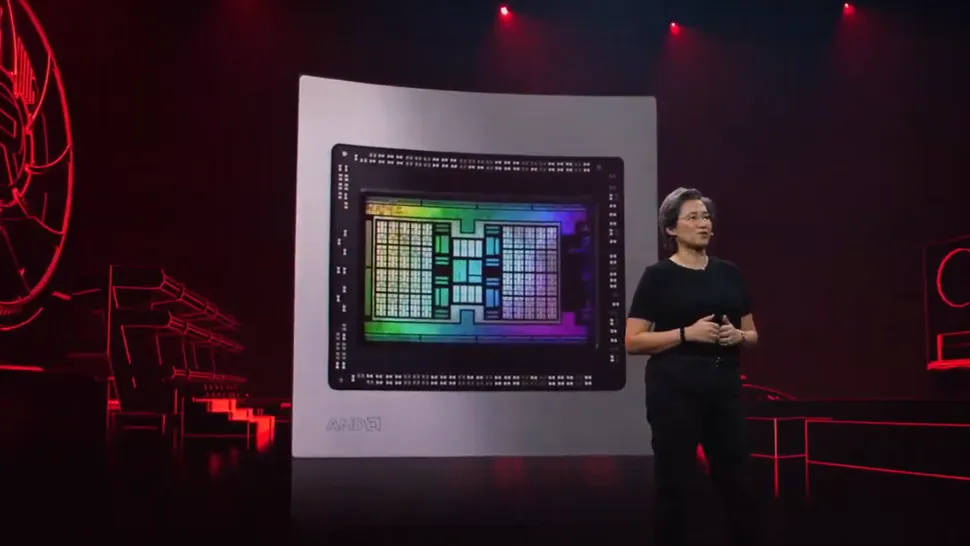
AMD dropped the Big Navi bomb (watch our stream from the event above), revealing the specifications for the Radeon RX 6800 XT, Radeon RX 6800... and, of course, something else: the Radeon RX 6900 XT. With it, they aim for the top of the benchmark rankings!
The names of the graphics cards are not surprising, and most of the details were guessed in leaks over the past few months. Now, however, we have the official data, and it's time to put an end to the speculation regarding the full specifications, prices, and comparative tests (from AMD*) at 4K and 1440p resolutions.
It seems that the company not only hopes to get close to Nvidia's Ampere cards but also has a good chance of even surpassing them in both performance and efficiency. Could we have a "Ryzen moment" in the GPU sector?
Summary data for AMD RX 6000 series
* Up to 5120 shader cores in RX 6900 XT, 3840 cores in RX 6800
* Maximum boost clock between 2.1-2.25GHz
* 16GB GDDR6 (not X) memory in all three shown cards
* 128MB "Infinity Cache" with more than 2 times the effective connectivity
* One "Ray" accelerator per CU (Compute Unit*), tenfold acceleration for RT calculations
* Prices start from $579 for RX 6800, $649 for RX 6800 XT, and $999 for RX 6900 XT (official MSRP prices for the USA*, expect prices for Bulgaria soon)
* The announced improvements from the FidelityFX package will compete against Nvidia's DLSS
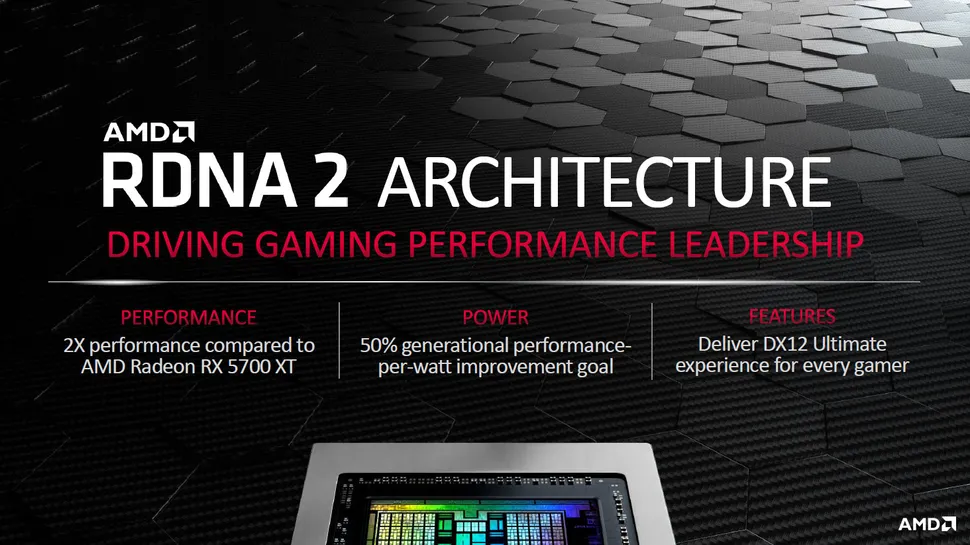
AMD Radeon RX 6800 XT specifications and expected performance
Let's start with the main contender, the Radeon RX 6800 XT. It will face off against the Nvidia RTX 3080, which "theoretically" costs $700 (in practice, it's almost impossible to buy it anywhere in the world right now, and when it is available - the price is much higher), but it is expected to be supply-constrained at least until early 2021. Due to Nvidia's difficulties, AMD may find itself in an extremely advantageous position with the RX 6800 XT, whose specifications and manufacturer data look extremely promising, especially at the lower starting price of $649 (MSRP). Here are the details:
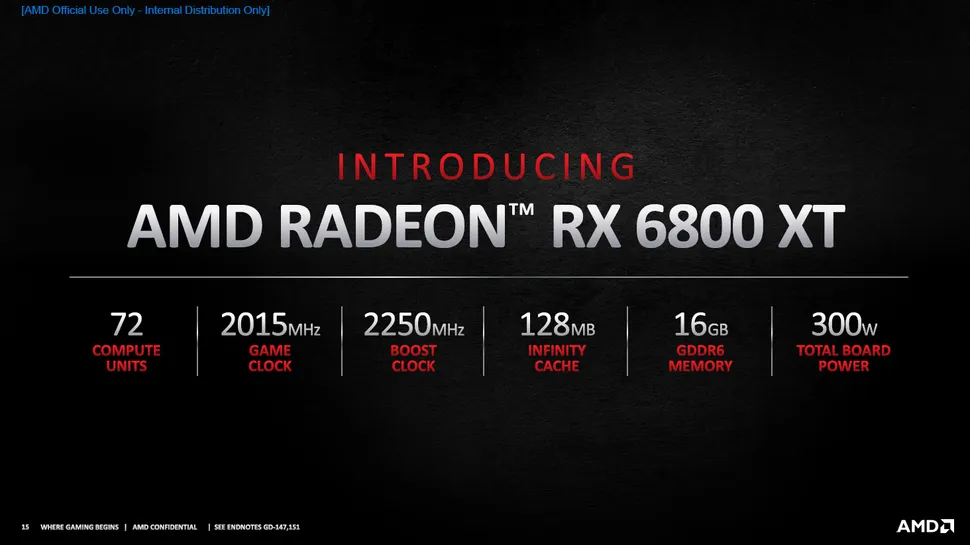
RX 6800 XT will feature 72 CUs (Compute Units), each with 64 shader cores. The gaming frequency is just over 2GHz, while the boost frequency will reach up to 2.25GHz. This totals to a peak computational power of 20.7 TFLOPS. Technically speaking, this is significantly lower than the 29.8 TFLOPS of the RTX 3080, but it should be noted that a large part of that, for Nvidia, goes to INT32 calculations.
It is still unclear whether AMD has added FP32 + INT32 operations to RDNA2/ Navi 2x, or if there are other optimizations that compensate for the apparent computational deficit. If there are, performance in real-world conditions will be quite close to that of the RTX 3080, and may even surpass it. Even if there is no support for competitive programming (a programming paradigm for creating computer programs in which numerous calculations can be executed in overlapping time periods, rather than sequentially**) INT + FP, however... Well, this is where innovation comes in, and probably the most interesting aspect of the new architecture, namely the 128MB "Infinity Cache".
In simpler terms - this is a huge cache. AMD did not go into details, but the main idea is to reduce the amount of memory traffic and thus increase effective connectivity, through a sufficiently large L3 (or L4?) cache that can hold the entire frame buffer - and even more. Reducing all this additional memory traffic can also improve overall efficiency - just as AMD claims. Using the same 256-bit GDDR6 interface, which seems to operate at "only" 14Gbps, according to AMD, the new "Infinity" cache reduces power consumption by 10%, while simultaneously increasing effective connectivity by a whopping 117%. If all this turns out to be true, in theory, it means that the RX 6800 XT has the equivalent of about 972GBps connectivity, which is much more than the RTX 3080.
It is important to highlight the other 2 values as well: 16GB total GDDR6 memory and 300W TBD (Total Board Power). This is 60% more for textures and other data compared to the RTX 3080. Given the 10GB of video memory on the RTX 3080, which is also sufficient, we would say that the extra memory on the Radeon would certainly be beneficial.
As for the 300W power, AMD and Nvidia do not always measure consumption in the same way, but AMD states that these are the total watts that their card will use. In practice, this means that it will consume 20W less than the RTX 3080, which often exceeds its official consumption values.
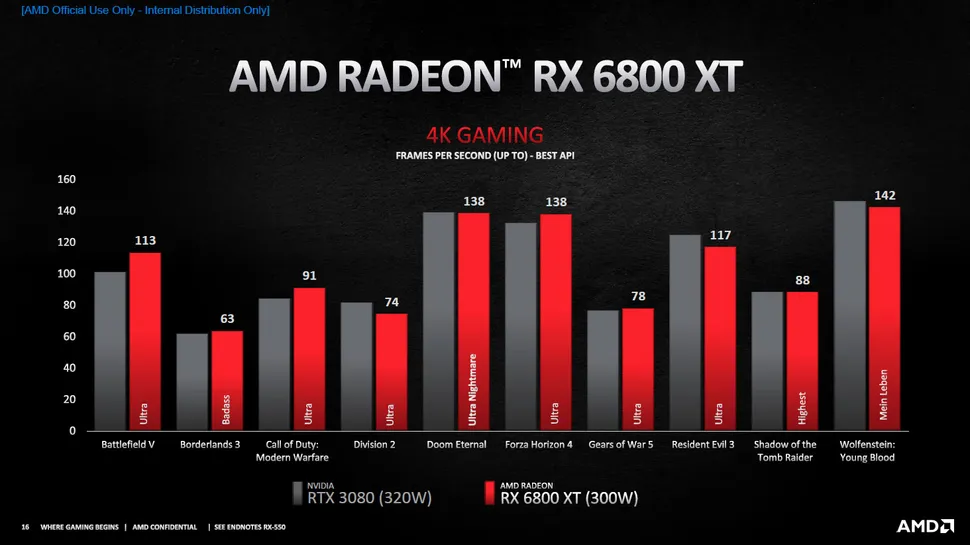
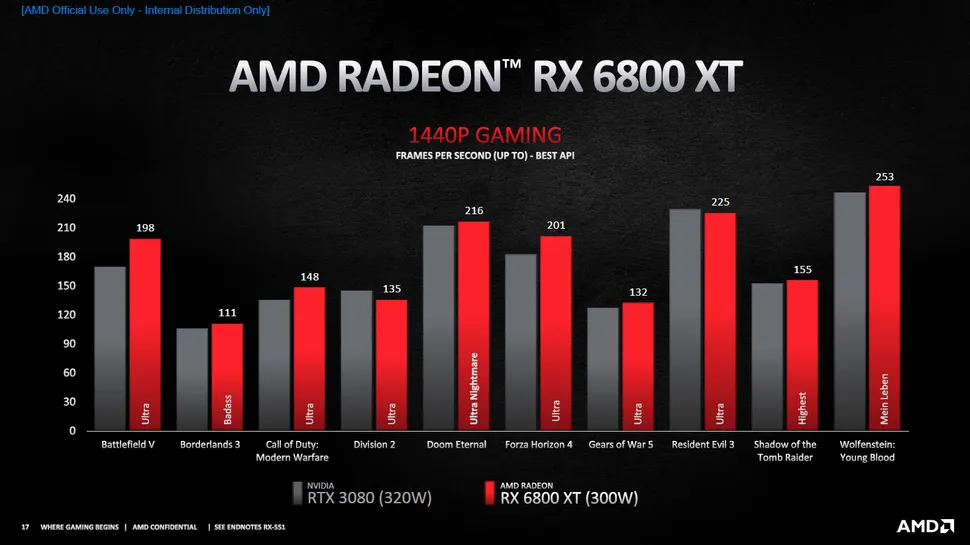
Here’s how the RX 6800 XT performs against the RTX 3080 in 4K and 1440p:
==============================================================
Online store for gaming computers, components, and peripherals:
 https://www.pcbuild.bg
Follow us on social media:


==============================================================