
Top 10 Most Significant GPUs from AMD
of All Time
There is a lot of graphic history and technology here that we can unpack. When AMD acquired ATI, they didn't just acquire the company, but continued their reputation as graphic giants for years to come. Looking back, we can see how AMD achieved this success, even though for many years things didn't look so rosy. Enthusiasts have seen some impressive products from their favorite graphics card manufacturers. Today, AMD prides itself on having the most efficient processors and graphics cards. With a wide range of products in history that can be represented by the ATI and AMD graphics lineup, there are a few select ones that push the industry forward, impress critics, and bring financial success to the company.
10. ATI VGA Wonder

The VGA Wonder series helped ATI stand proudly on the map in the late 80s. The VGA Wonder was an added card for IBM personal computers in the late 80s, offering up to 512kb of video memory. It allowed display resolutions of 1024x768 and included automatic mode switching. Subsequent models like the Wonder 16 and VGA Edge helped spread the name of ATI, and eventually, the VGA Wonder series was consolidated and then replaced by the Mach 2 2D accelerator series. Graphics cards from this era even included a mouse input port.
9. ATI Rage 128

The 3D Rage was announced as the company's first 3D accelerator, hoping to enhance its high-quality 2D performance with more features. However, the graphics card missed its chance with Z-buffering, meaning it didn't become a strong competitor to rivals like Nvidia NV1. Fortunately, the card was followed by Rage II. Rage 128 helped bring ATI to the mass market, delivering performance on par with Nvidia RIVA TNT and Voodoo 2. Rage 128 could do this by offering higher performance with a high-quality 32-bit color mode. Some competitors didn't even offer this mode! High-performance enthusiasts following Rage 128 included Rage Fury MAXX, which featured dual graphics processors on a single board, a design that ATI (and AMD) would rely on in the future. Expectations for the 64 MB Fury MAXX became impossible. Unfortunately, the card's price and operating system support limited its success.
8. ATI Radeon DDR

Although ATI never managed to meet the criteria, the products they offered were generally high with attractive prices. Radeon DDR with its faster memory, released in August 2000, shows how committed ATI was to the gaming graphics card market. With 64 MB of memory and a large number of transistors, Radeon DDR introduced new features like environmental bump mapping – in addition to brand new support for DirectX 8. Thanks to its 32-bit color performance and support for video inputs and outputs, Radeon DDR is an important highlight in ATI's history.
7. ATI Radeon 9700

By 2002, ATI had built a decent reputation, offering graphics cards with many features even if they didn't always provide the fastest 3D rendering. Things changed when ATI acquired ArtX, whose people designed the graphics chips in Nintendo 64 and Nintendo GameCube. As a result, the third-generation Radeon was monstrous in almost every aspect. It was the first card to offer support for DirectX 9, including shader, vertex, and pixel models 2.0. Moreover, its flip chip GPU package allowed the card to run cooler and at higher clock speeds. This card outperformed the best Nvidia GeForce 4 Ti 4600 in 3D performance, enabling demanding features like anti-aliasing and anisotropic filtering. This generation of graphics cards was not only popular among enthusiasts with deep pockets, as some mid-range Radeon 9500 models could be modified into 9700 with some minor tweaks, further increasing the value of ATI's products. This managed high frame rates in games for several years.
6. Enter console graphics: Flipper and Hollywood

It is important to mention the Flipper graphics technology behind the Nintendo GameCube. Designed by ArtX, which was later acquired by ATI, Flipper includes several smart features that keep the chip efficient and cost-effective. Although the GameCube is cheaper and smaller than other consoles on the market, it boasts similar graphics quality and even some impressive effects, including the paint in Super Mario Sunshine and the water in WaveRunner. The GameCube and Flipper are a brief note compared to the Nintendo Wii and its Hollywood graphics processor, which was also designed by ATI during its acquisition by AMD. While the technology is only 50 percent faster than Flipper in the GameCube, the commercial success of the Wii is a huge win for AMD, as the console enjoys massive sales year after year (I even occasionally play on my personal Wii). With over 100 million Wiis sold, AMD and ATI are not only in the personal computer market but also in consoles, opening up an entirely new segment for the company. AMD's graphics technologies are part of the equally successful today Wii U, Xbox 360, Xbox One, PlayStation 4, Xbox Series X / S, and PlayStation 5.
5. AMD Fusion APUs

After acquiring ATI, the next logical step is to combine their technology. Called Accelerated Processing Unit or APU, these chips find success in markets beyond traditional gamers and PC enthusiasts – for example, embedded low-power solutions and mobile chips or HTPCs and size-conscious consoles. The first APUs from AMD, marketed as Fusion, arrived in 2011 with the Brazos platform, which could compete with the best Intel Atom processors and Nvidia's Ion graphics processors with a single chip. On the desktop side, the A8 series APU shows that AMD can combine strong CPU performance with 3D rendering, which can outpace Intel's integrated graphics. This means that AMD can provide a comprehensive solution for many markets.
4. ATI Radeon HD 4870

With the launch of the ATI Radeon HD 4850 and 4870, the company impresses gamers with products that can keep up with Nvidia's leading chips but at lower prices. Even when Nvidia releases its GTX 260 and GTX 280, the Radeon cards appear to be the better option as they are more affordable yet still within the same performance range. The HD 4870 is also among the first cards to use GDDR5, leading Nvidia by more than a year. When ATI needs a new benchmark improvement, the HD 4870 X2 arrives, bringing more challenges for the competition.
3. ATI Radeon HD 5970
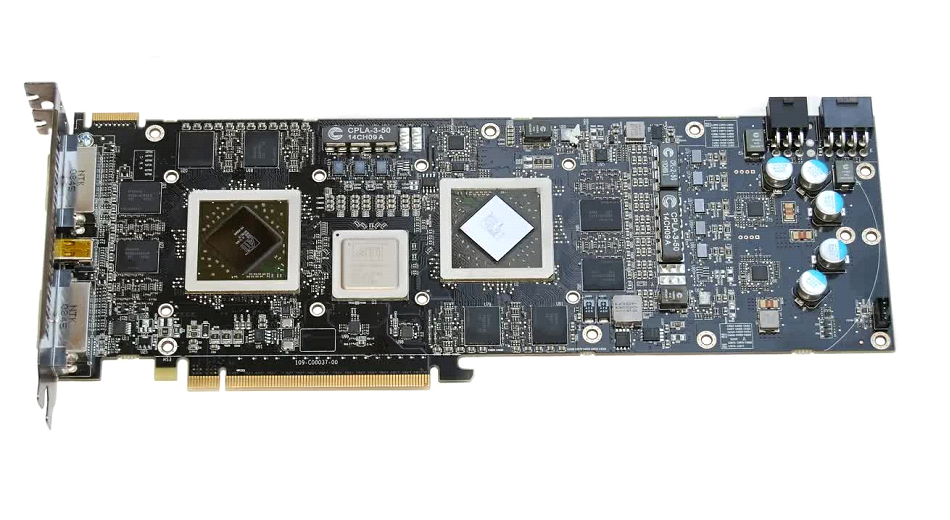
Perhaps ATI's greatest achievement at the end of the first decade of the new century is the Radeon HD 5970, a card that dominates everything before (and after its release due to some issues with TSMC that delay Nvidia's 40 nm process). The card packs an incredible number of stream processors (3200!), a 725 MHz core clock, and dual 1 GB GDDR5 banks, as this is a dual GPU layout. Another significant addition to this card is Eyefinity, ATI's display controllers that allow six simultaneously active displays. These cards were highly sought after for their time with many enthusiasts frustrated by the limited supply.
2. AMD Radeon HD 7970
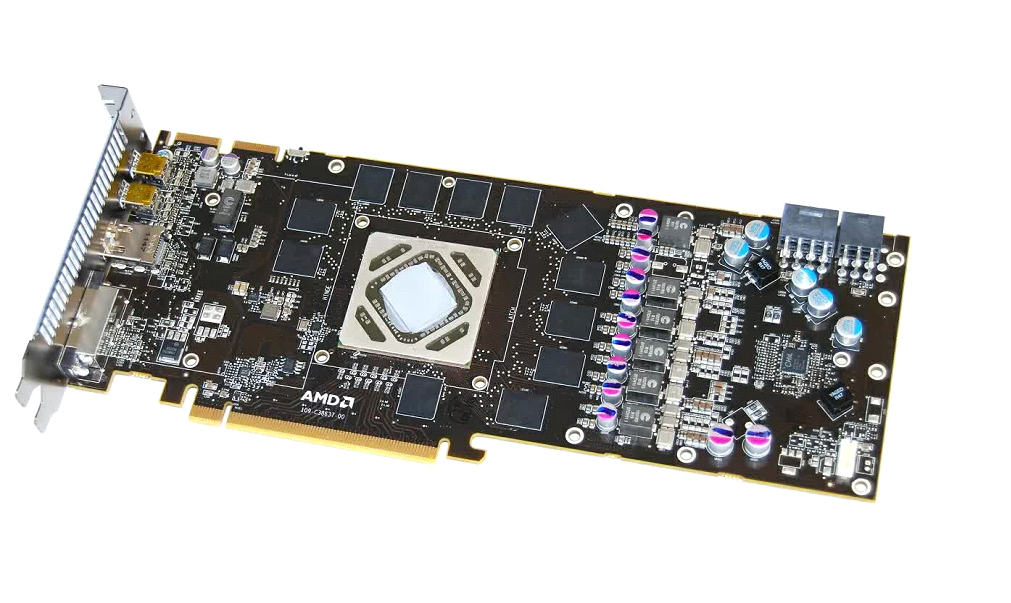
The first PCI-Express 3.0 card, not to mention the first product to use the Graphics Core Next (GCN) architecture, is the flagship Radeon HD 7970. GCN means that the card is a solid general-purpose graphics processor (GPGPU) and could perform well in gaming as well. The fast refresh of the 7970 is the GHz edition, which boosts the clock speed to 1000 MHz and includes a boost feature that increases it to 1050 MHz, a feature we still see in AMD cards today. The GCN architecture used in this card lays the foundation for several important products down the line, including the R9 290X, R9 Fury X, Polaris-based cards like the RX 480, and the RX Vega series.
Features like Freesync with variable refresh rate debut in third-generation GCN products, while the R9 Fury X and Vega models feature high-bandwidth memory that helped them appeal to professional users, not just gamers.
⦁ AMD Radeon RX 5700

The Radeon RX 5700 includes GDDR6 and uses a 7nm manufacturing process. These two aspects help improve performance and pricing. Best described as a mid-range product with fewer stream processors than previous Vega cards, the RDNA / Navi 5700 XT manages to compete with the leading card from the previous generation (Radeon VII) in gaming at a more affordable price. The RX 5700 is followed by the RX 6800 and 6900 XT series, which help AMD regain the top spot in gaming benchmark rankings. The technology behind these cards is also used in the latest generation of gaming consoles, PlayStation 5 and Xbox Series S and X. This shows that AMD has what it takes to deliver gamers the ultimate experience regardless of the platform.
35 years later: How many of these cards have you seen or used?
Cards from the AMD Radeon RX 6000 series can be found in stores and on the site - AMD Radeon
==============================================================
Online store for gaming computers, components, and peripherals:
 https://www.pcbuild.bg
Follow us on social media:


==============================================================