
Recently, AMD made the slightly strange decision to expand their Ryzen 4000 range of processors. They are based on the slightly older Zen 2 architecture and unlike their Ryzen 3000 predecessors, they feature the Renoir APU for their integrated graphics, but with some modifications.
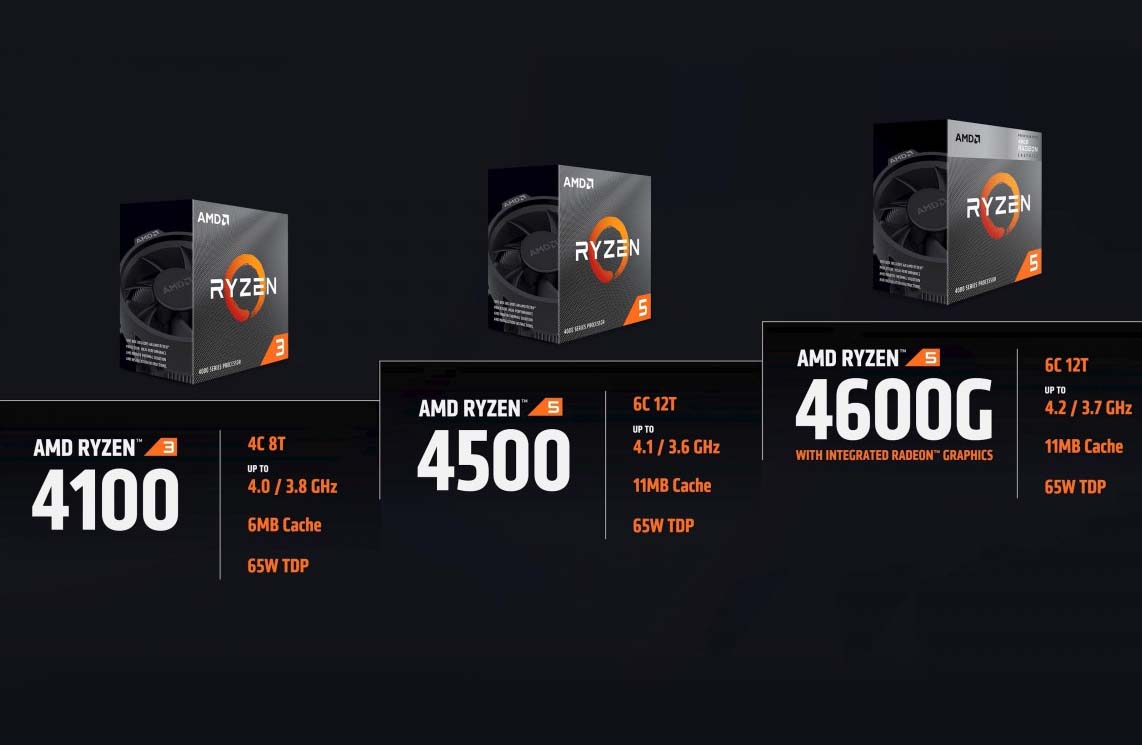
The highest processor from the budget series that AMD has provided us is the Ryzen 5 4600G. It features 6 cores and 12 threads, reaching a base frequency of 3.7GHz and a boost of 4.2GHz. As you might guess, the presence of the letter G in the name indicates that the processor also has an integrated graphics card, which can be used for everyday activities - watching movies, social media, work, even light gaming - for example, esports games. The successor to the popular Ryzen 5 3400G - the 4600G has 11MB of cache memory and a 65W TDP.
In its "box" variant, it also comes with a Wraith Stealth cooler, thanks to which you can comfortably allocate part of your budget for your new configuration to other components.
Although the Ryzen 5 4600G has integrated graphics, it could easily be combined with a separate graphics card for much more serious gaming.
Next in the series is Ryzen 5 4500. It also features 6 cores and 12 threads, but here the frequencies are slightly lower. In other words - 100MHz less, namely a base frequency of 3.6GHz and a boost of 4.1GHz. However, there is no change in cache memory and TDP - 11MB and 65W. As you can see, the two processors are quite similar, but the main difference is that the letter G is absent here. This tells us that it does not have integrated graphics and will necessarily need to be combined with a separate graphics card. The Ryzen 5 4500 can be purchased in both "box" and "MPK" variants, and in both cases, it comes with the aforementioned Wraith Stealth cooler.
Finally, AMD presents us with its most budget-friendly model - Ryzen 3 4100. Unlike its larger siblings, it features 4 cores and 8 threads. The frequencies are also slightly lower - 3.8GHz base and 4.0GHz boost. Similar to the Ryzen 5 4500, it also does not have integrated graphics, which, as you might guess, automatically means that you will need a separate graphics card in your configuration. The cache memory this time is 6MB, and the TDP is again only 65W. It is hardly a surprise that we also have "box" and "mpk" variants here, with the already familiar Wraith Stealth cooler.
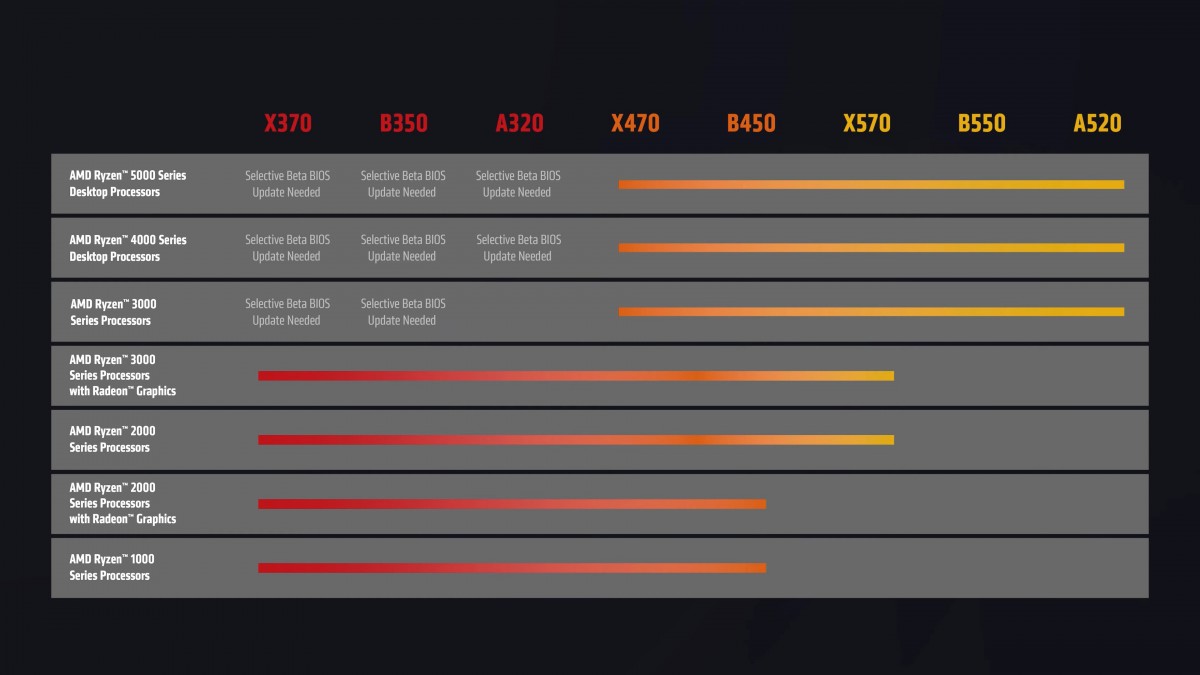
Something important to mention is that both Ryzen 4000 and 5000 processors are now supported even on the first motherboards with series 300 chipsets (A320, B350, X370), and of course, newer and current ones. This makes them attractive options for people with older Ryzen-based configurations looking for a relatively cheap upgrade, as well as for those with a limited budget who want to build a new computer. Keep in mind, also, that the Ryzen 4000 series, as well as the Ryzen 5 5500, only support PCIe up to version 3.0. If you need 4.0 support, it is advisable to look towards some of the higher-class processors and motherboards, such as the B550 or X570 chipsets.
Who else are these processors for? AMD's main target group is people who do not have high demands or the need to own the most powerful and expensive processors. They are sufficiently adequate for everyday work or gaming, and can easily be combined with a lower-class graphics card. In combination with almost any motherboard released on the market (and supporting Ryzen processors, respectively) in recent years and of course, the recommended 16GB of RAM, which is still sufficient for almost everything you can think of, you can build a quite decent and affordable configuration.
In addition to the Ryzen 4000, AMD has also released 4 more processors from the 5000 series. You can read more about them in this article: https://pcbuild.bg/blog/222-novi-popalneniya-v-ryzen-5000-seriyata-procesori-na-amd